The Revival of Hellenic Polytheism in Modern Greece
By Alexia Costadina
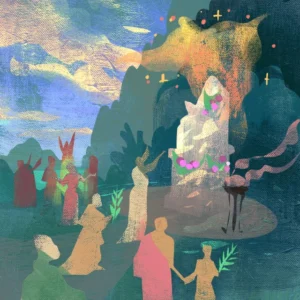
For the first time in an unforgivable amount of time, the slopes of Mount Olympus are beginning to once again glow with torchlight. The air starts to hum with orphic hymns and the sounds of the lyre as the Hellene people across modern Greece pour libations of honey and wine to their Gods. In the foothills written about in mythology, you may see the shadows of worshippers standing in a circle, calling on the Theoi (the old Gods of Greece) with reverence. For the first time in nearly two thousand years, the divine names of Olympus are being spoken not as a Hollywood character, but as prayer. There are not many of us, but the number grows each month.
It grows now; the revival is here. But why must the revival exist? What happened to the Hellenic way?
The religion of ancient Greece, a labyrinth of gods, spirits, daemons, ancestors, and sacred festivals was officially outlawed in 380 CE. Emperor Theodosius declared Christianity, eastern orthodoxy to be precise, the state faith of the Roman Empire. A Roman empire that would divide Greece not only geographically but spiritually. Though the Greek way of life and key areas in Greece held symbolic prestige and respect from the Romans, the Romans held all the power. Decimating the Polis and their sovereignty as well as the deep historical and intrinsic link they held to the ancient Greek religion, the polytheistic foundation from which they thrived.
What followed was a slow eclipse: temples closed, monuments stood mutilated, libraries burned, and worship was driven into secrecy. By the time the Byzantine Empire flourished, the word “Hellene” no longer meant “Greek,” but “pagan.”
And yet, despite the decimation of this beautiful, sacred way of life, the old ways never entirely died. Folklore preserved remnants. The nymphs hidden in springs, the rituals steeped in celebration, the offerings of bread and wine at secret household shrines. When Greece fought for independence in the 1820s, Orthodoxy became the face of national unity, but the voice of the gods lingered. Yu could find it in language, shrines forgotten, and mythology that still taught the moral lessons of our ancestors.
Today, after far too long Greece’s constitution cites freedom of religion. Behind this society unfortunately allowed their disdain for the ‘pagan’ ring loudly. Quietly, despite this, Hellenic Polytheism as we know it today, has re-emerged into the light. The Supreme Council of Ethnikoi Hellenes (YSEE), has become the most visible organisation representing practitioners of the ancestral religion. Though it has its fair share of controversy which I will not comment on, it has boldy decaled its, and its religion’s place in modern Greece. Its members describe their faith not as reconstruction, but as restoration. Telling all that will listen that it is “a living continuation of the Hellenic ethos.”
In 2017, the Greek state officially recognised Hellenic Polytheism as a “known religion,” granting it legal rights to perform ceremonies, own temples, and register clergy. A move highly criticized by the church. This in itself was a milestone, one that Hellenic Polytheists in Greece wouldn’t dare to believe would happen. Certainly couldn’t be topped, until it was. In 2025 a new temple was built in Arcadia, dedicated to the Olympian gods. The first of its kind in 1,700 years.
In recent years the summer months brought hundreds to the sacred slopes of Olympus to celebrate the Prometheia Festival, a celebration of fire, freedom, and divine remembrance. The ceremonies are conducted in ancient Greek accompanied by music, theatre, and ritual dance. For many, it feels like a homecoming, a homecoming attended by the spirit of our ancestors.
Despite legal moves to create the perception of acceptance of the old way, Greece is Orthodox, its identity is orthodox. Approximately 84% of the population identifies with the Church. Orthodox icons hang in classrooms, courtrooms, and homes. Many clergy and members of the public are openly suspicious and hostile towards the re-emergence of paganism. They feel this even though the revivalists, the Hellenes, state openly that they have no agenda. No goal to dethrone Orthodoxy. Their sole aim to reclaim their heritage and connect with their ancestors, Gods and spirits of their land. Younger Greeks like me, disenchanted with institutional religion, are increasingly drawn to this path, if not drawn certainly not against. Many understand that it celebrates the divine in nature and the sacredness Kosmos.
I have a drive, a life goal to return to the old ways. Not to challenge the church but for the sake of continuity. Daily I experience a yearning to reconnect with the Hellenic spirituality. A calling to teach the true essence of this path, rooted in sunlight and stone, poetry and philosophy.
Offerings to Hestia, libations to Dionysos, prayers to Athena — these are acts of reconnection, not rebellion. Its inherently Greek but not limited or closed to Greek people. Hellenic Polytheism teaches that divinity is not a distant ideology but a living theology presenting in the earth, sea and pulse of human creativity. It recognises sacred reciprocity: give honour, and the gods will honour you.
In 2026 I will be moving forward with this teaching, teaching with the understanding that my journey is not complete. It can never be.
I will ensure that people welcome the return of the Gods, honour their presence and respect the land they came from even when the land and its people themselves show little respect for the Gods.
The Gods are speaking again through those who dare to listen. Those who dare to question the watered-down version of Hellenic Polytheism we see practise across the world, not through malice but as a product of inaccessibility to knowledge.
If you would like to access this knowledge, if you wish to journey through today’s modern world accompanied by the spirit of the ancestors of Greece join me, to learn, to celebrate the revival and to welcome the Gods as they return to the mountain.